
Horse Hoof Supplements: Biotin, Zinc, and What the Research Actually Says
A nutritionist breaks down hoof supplements for horses — what the research supports, what's marketing noise, and realistic timelines for results.
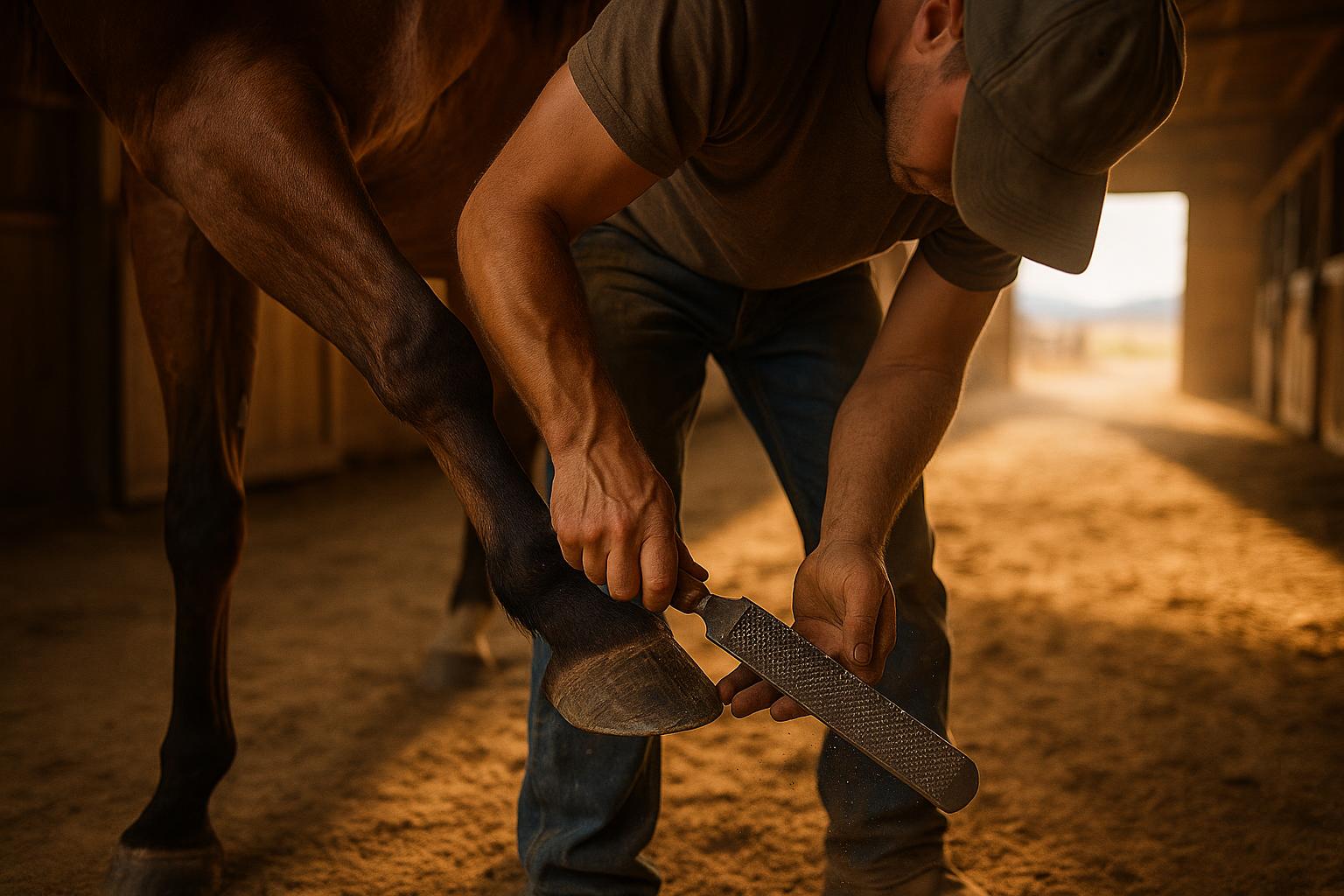
Your horse's hooves are growing right now. About one centimeter per month. That means the hoof wall your farrier trims today reflects what your horse ate six to nine months ago — not the supplement you started last Tuesday.
This timeline matters because the hoof supplement market thrives on impatience. You notice cracks, chips, or slow growth. You buy a product. You want results in weeks. But hoof horn is keratin — a structural protein built slowly from the coronary band down. A full new hoof wall takes nine to twelve months to grow out completely. Any product promising faster results than biology allows is selling you hope, not science.
I evaluate hoof supplement programs the same way I evaluate everything else: start with what the research actually supports, check whether the horse's baseline diet already covers it, and only then decide if a supplement fills a genuine gap.
What the Research Supports — and at What Dose
The published research on equine hoof quality points to four nutrients with real evidence behind them. Everything else on the label is either borrowed from human or livestock studies, present at negligible doses, or flat-out unsupported.
Biotin is the most studied hoof nutrient in horses. Multiple controlled trials — including work by Josseck, Zenker, and Geyer published in peer-reviewed veterinary journals — demonstrate that biotin supplementation at 20 mg per day improves hoof horn quality in horses with pre-existing hoof problems. The key details most labels leave out: the effective dose in the research is 20 mg/day for a 500 kg horse, improvements take six to nine months to become visible, and the benefit is primarily in horses that were biotin-responsive (not all horses with poor hooves are). Biotin at 5 mg/day — which is where many cheaper products land — has not shown consistent results in the literature.
Zinc is essential for keratin synthesis and the enzymatic processes that build hoof horn. Zinc deficiency produces slow hoof growth, weak horn, and poor wall integrity. The NRC requirement for a 500 kg horse at maintenance is roughly 400 mg/day of zinc, but many hay-based diets — particularly in the western US — deliver less than that. Zinc oxide is the cheapest supplemental form and has lower bioavailability than zinc methionine or zinc proteinate. The form on the label matters.
Copper works in direct ratio with zinc. Copper is required for the cross-linking of keratin fibers that gives hoof horn its structural strength. The recommended copper-to-zinc ratio is approximately 1:3 to 1:4 (copper to zinc). When you supplement zinc without matching copper, you can actually suppress copper absorption and make hoof quality worse. This is one of the most common mistakes I see — a hoof supplement loaded with zinc and no copper, or copper at a ratio that doesn't match.
Methionine (and its active form, DL-methionine) is a sulfur-containing amino acid directly involved in keratin production. Methionine provides the sulfur bonds that give hoof horn its hardness and resilience. Horses on low-protein or poor-quality forage are most likely to be methionine-limited. Supplementation at 5–10 grams per day has shown benefit in horses with documented protein-quality gaps in their diet.
That's the short list. Biotin at 20 mg/day, zinc in a bioavailable form at adequate daily intake, copper in correct ratio to zinc, and methionine if the diet is protein-limited. Four ingredients. The research is clear, and it's been clear for over two decades.
What's Marketing Noise
Walk through the hoof supplement aisle — physical or digital — and you'll find labels listing fifteen, twenty, sometimes thirty ingredients. Most of those ingredients fall into three categories: present at sub-therapeutic doses, unsupported by equine-specific research, or redundant with what the horse already gets from feed and forage.
Gelatin and collagen peptides appear in many hoof products. The theory is that providing collagen precursors supports hoof structure. The problem: horses break down ingested collagen into amino acids during digestion, just like any other protein. There is no mechanism for dietary collagen to travel intact to the hoof and become structural material. If the horse is getting adequate protein and methionine from its diet, supplemental gelatin adds nothing measurable to hoof quality.
MSM (methylsulfonylmethane) is a sulfur donor that shows up in both joint and hoof supplements. MSM has some evidence for anti-inflammatory effects in joints, but its role in hoof horn production specifically is not well established in controlled equine trials. It's not harmful, but listing it as a primary hoof ingredient overstates the evidence.
Omega-3 fatty acids support overall coat and skin health, and healthy skin at the coronary band does support healthy hoof growth. But omega-3s are a general health nutrient, not a targeted hoof intervention. If you're already supplementing omega-3s for other reasons, you don't need them duplicated in your hoof product.
Calcium at high doses in hoof supplements concerns me. Calcium competes with zinc and copper for absorption. A hoof supplement that loads calcium alongside its zinc and copper may be undermining the very minerals it's supposed to deliver.
The label test is simple: does this product deliver biotin at 20 mg/day at the recommended feeding rate? Does it include zinc and copper in bioavailable forms at a correct ratio? If the answer to either question is no, the product is not aligned with the research — regardless of how many other ingredients pad the label.
Why Forage Quality Matters More Than Your Supplement Choice
Here is the conversation most hoof supplement companies don't want to have: the majority of hoof problems in domestic horses trace back to the base diet, not to a missing supplement.
A horse on lush, mineral-rich pasture is getting biotin, zinc, copper, and methionine from its forage. The biotin content of fresh green pasture and well-cured grass hay can meet or approach the horse's baseline needs. Zinc and copper levels depend heavily on soil mineral content — and this is where geography becomes the deciding factor.
In much of the western US, including here in Montana, soils tend to run low in zinc and selenium. Grass hay grown on these soils reflects that deficiency. A horse eating exclusively western grass hay may be consuming adequate calories, adequate fiber, and adequate protein — but running chronically short on zinc and copper. That horse has a genuine gap a hoof supplement can fill.
Contrast that with a show horse on a premium commercial feed plus a ration balancer plus two or three supplements. That horse may already be receiving 30–40 mg of biotin per day, well above the research threshold, before you add a dedicated hoof product. Stacking another hoof supplement on top is redundant money.
This is why I tell every client the same thing: get a forage analysis before you spend money on a hoof supplement. A forage analysis from a lab costs less than two months of most commercial hoof products and tells you exactly what your hay provides. From there, you can calculate whether zinc, copper, or biotin actually needs supplementing — or whether your horse's hoof issues have nothing to do with mineral gaps at all.
The horses that benefit most from hoof supplementation are typically the ones nobody markets to: pasture horses on marginal forage, horses on dry lot eating low-quality grass hay, horses in regions with mineral-depleted soils. The show horses in premium programs are, ironically, the least likely to need a dedicated hoof product — and the most likely to buy one.
The Biotin Question: Does Every Horse Need It?
Biotin deserves its own section because it dominates the hoof supplement conversation — and the nuance matters.
Biotin is a B-vitamin. Horses synthesize biotin via hindgut fermentation, and they also obtain it from forage. A healthy horse on adequate forage with a functioning hindgut is likely producing and consuming enough biotin for normal hoof growth. Not every horse with cracked hooves is biotin-deficient.
The research showing benefit from biotin supplementation specifically studied horses with pre-existing hoof quality problems — cracking, crumbling, slow growth, soft horn. In those horses, supplementation at 20 mg/day for six to twelve months produced measurable improvement in horn hardness, growth rate, and structural integrity. But horses with healthy hooves showed no additional benefit from supplementation. Biotin isn't a performance enhancer for hooves that are already sound.
If your horse has persistent hoof quality issues and you want to trial biotin, here's how to do it properly:
- Confirm the dose. The product must deliver 20 mg of biotin per day at the label feeding rate. Many products deliver 10 mg or less — which is below the threshold shown effective in the research.
- Set a realistic timeline. Visible improvement takes six to nine months minimum. The new horn grows from the coronary band, so you won't see the effect of today's supplementation until that horn reaches the ground surface.
- Define your measurement. Before you start, photograph the hooves from the front and sole. Ask your farrier to note hoof wall quality, growth rate, and any specific concerns. Repeat the documentation every trim cycle. Without a baseline, you cannot objectively evaluate whether the supplement changed anything.
- Control the variables. If you change the diet, the turnout, the footing, and the hoof supplement simultaneously, you have no idea which variable drove any improvement. Change one thing at a time.
This is the same evaluate-and-measure framework I use for every supplement category. The methodology matters more than the brand on the label.
Zinc and Copper: The Ratio Most Labels Get Wrong
I've already mentioned the zinc-to-copper ratio, but it's worth emphasizing because getting this wrong actively harms hoof quality rather than just wasting money.
Zinc and copper compete for the same absorption pathways. High zinc intake without proportional copper suppresses copper uptake. Copper deficiency shows up as weak connective tissue, poor hoof wall integrity, and faded or sun-bleached coat color. I've seen horses whose owners were faithfully supplementing a zinc-heavy hoof product and couldn't understand why the hooves were getting worse — the product was creating a copper deficiency.
The target ratio is 3:1 to 4:1 zinc to copper. If your hoof supplement provides 400 mg of zinc, it should provide 100–130 mg of copper. If it provides 400 mg of zinc and 20 mg of copper — or no copper at all — that product is poorly formulated regardless of how many endorsements it carries.
Check the ratio against what your total diet provides, not just the supplement in isolation. Your hay has zinc and copper. Your grain or ration balancer has zinc and copper. The hoof supplement adds more. The ratio that matters is the total daily intake across all sources.
Realistic Expectations: What Improvement Actually Looks Like
A hoof supplement that works — meaning the horse had a genuine deficiency that the product corrected — produces changes you can document but not rush.
Months one through three: The new horn growing from the coronary band may show improved texture, but the visible hoof wall is still old growth. You might notice the hoof feels harder at the coronary band during grooming. Your farrier might comment that the new growth looks different from the old growth at trimming.
Months four through six: A visible growth line may appear on the hoof wall — a demarcation between the older, weaker horn below and the newer, denser horn above. Growth rate may have increased slightly. The horse may hold shoes better or chip less between trims.
Months nine through twelve: The full hoof wall has turned over. If the supplement addressed a genuine deficiency, the difference between "before" photos and current hooves should be obvious. If you can't see a difference after twelve months of consistent supplementation at the correct dose, the supplement is not addressing the actual problem — and the actual problem needs investigation by your vet or farrier.
That investigation might reveal mechanical issues (poor trimming angles, inappropriate shoeing), environmental factors (standing in wet footing, abrasive surfaces), metabolic conditions that affect hoof quality, or a dietary gap the supplement didn't cover. Hoof supplements address nutritional causes of poor hoof quality. They do not fix mechanical, environmental, or metabolic causes.
Building a Hoof Program That Makes Sense
If I'm evaluating a horse's hoof supplement program, here's the sequence:
First, I want a forage analysis. What does the hay actually provide in zinc, copper, and overall protein quality? Without this, any supplement recommendation is a guess.
Second, I catalog everything the horse is currently eating — grain, ration balancer, all supplements — and calculate total daily intake of zinc, copper, biotin, and methionine across all sources. This step surfaces redundancy almost every time. Many horses are already receiving adequate zinc and copper from their commercial feed and don't need a separate hoof supplement to add more.
Third, if there is a genuine gap — zinc below 400 mg/day total, copper below 100 mg, biotin below 20 mg, or methionine limited by low forage protein — I recommend the simplest, most cost-effective way to fill it. Sometimes that's a hoof supplement. Sometimes it's a ration balancer that covers the mineral gaps across the board. Sometimes it's switching to a better hay source, which fixes the problem at the foundation rather than patching it with a product.
Fourth, I set a documentation schedule. Photos at every trim cycle. Farrier notes on horn quality and growth rate. A twelve-month evaluation window before making any judgment about whether the intervention worked.
This isn't complicated. It just requires patience and specificity — two things the supplement aisle doesn't reward.
When to Involve Your Vet or Farrier First
Poor hoof quality is a symptom, not a diagnosis. Before spending money on supplements, rule out the non-nutritional causes that no supplement can fix.
Chronic hoof problems that don't respond to dietary correction — or that appear suddenly — warrant a veterinary evaluation. Metabolic conditions, chronic inflammation, and circulatory issues all affect hoof quality from the inside, and those require medical management, not mineral supplementation.
Your farrier is your first-line hoof expert. Trim cycle, balance, angle, and mechanical load on the hoof wall matter at least as much as what goes into the feed bucket. A well-trimmed hoof on marginal nutrition often looks better than a poorly trimmed hoof on the best supplement program money can buy.
I work alongside vets and farriers — my role is the nutritional piece of the puzzle. When all three pieces align, hooves improve. When the nutritional piece is addressed in isolation, results are inconsistent at best.
If you're not sure whether your horse's hoof issues are nutritional, mechanical, or something else — or if you want help evaluating what your current supplement stack is actually delivering — book a consultation. I'll look at the whole picture: forage, feed, supplements, and what the hooves are actually telling us.
Pure Horse Nutrition provides equine nutrition consulting and educational information. Montana Lowden is not a licensed veterinarian. The information and services provided are not intended to diagnose, treat, cure, or prevent any disease. Always consult your licensed veterinarian regarding your horse's health.
Montana Lowden
Certified equine and human nutritionist. AQHA World Show competitor and Canadian Nationals Horsemanship Champion. Based in Missoula, Montana.
More about MontanaGet articles like this in your inbox.
Bi-weekly notes from Montana — case studies, science, and what's actually working in the barn.