
Horse Vitamin E Supplements: Why Most Horses Are Deficient and What to Do About It
Most stalled and dry-lot horses are vitamin E deficient and their owners don't know it. Here's how to test, what to supplement, and which forms actually absorb.
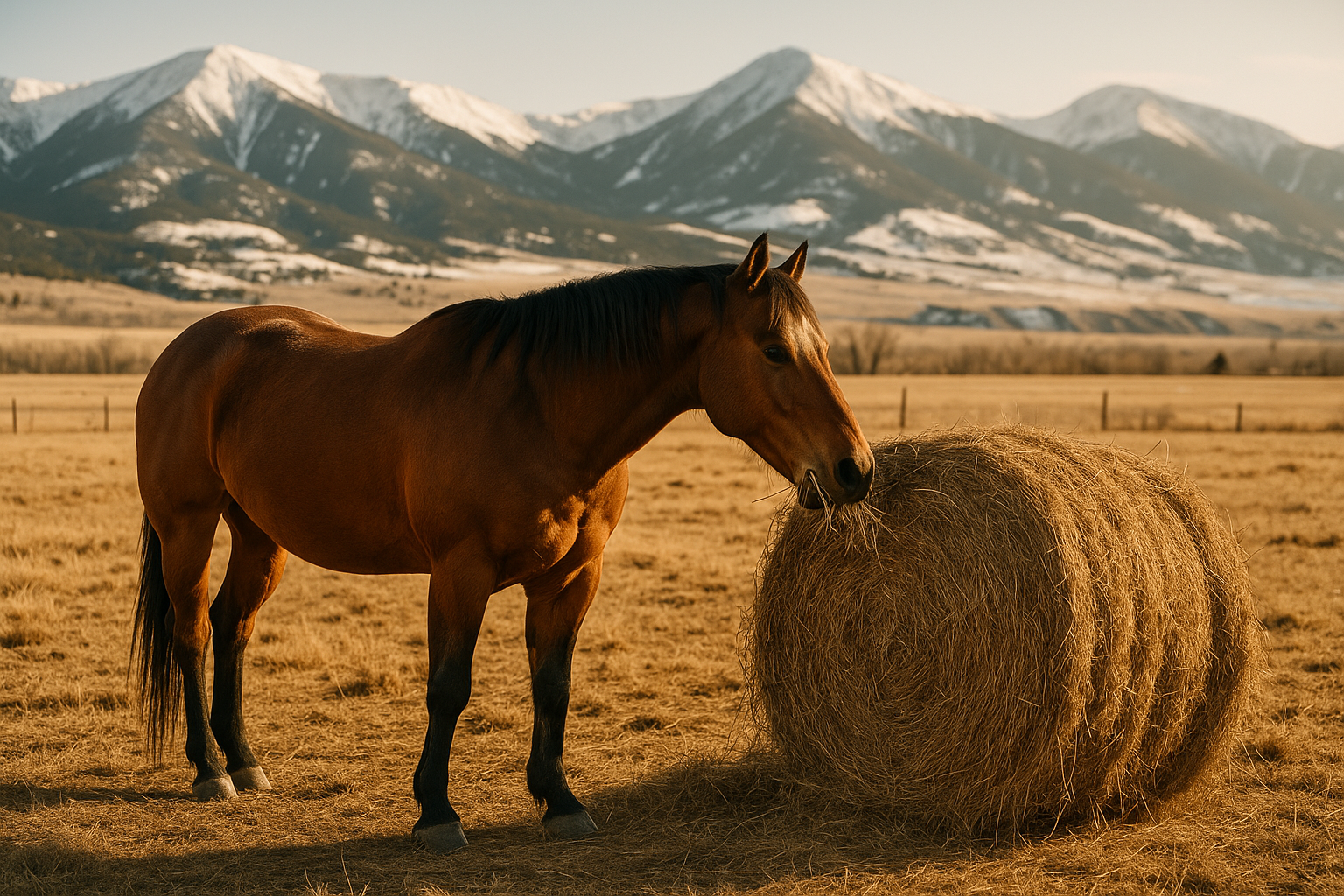
If your horse lives on pasture twelve months a year — lush, green, actively growing pasture — you can probably stop reading. Your horse is likely getting enough vitamin E from the grass under its feet.
But if your horse is stalled, on a dry lot, eating hay as its primary forage, or lives anywhere with a real winter, keep going. Because vitamin E is one of the most common nutritional deficiencies I see in the horses that come through my practice, and it's also one of the most quietly destructive. By the time the obvious symptoms show up, the deficiency has been building for months — sometimes years.
This isn't a fringe concern. This is the majority of domesticated horses in North America.
What Vitamin E Actually Does
Vitamin E — specifically alpha-tocopherol — is the primary fat-soluble antioxidant in your horse's body. Its job is protecting cell membranes from oxidative damage. That matters most in two places: muscle tissue and nerve tissue.
Muscle cells generate enormous amounts of oxidative stress during work. Vitamin E neutralizes the free radicals produced during exercise before they damage the membrane structures that allow muscles to contract and recover normally. Without adequate vitamin E, muscle membranes become fragile. Recovery slows. Susceptibility to tying-up increases.
Nerve cells are even more vulnerable. The myelin sheaths that insulate nerve fibers and allow electrical signals to travel efficiently are lipid-rich structures — exactly the kind of tissue oxidative damage targets first. When vitamin E status drops low enough, nerve tissue starts degrading. That degradation is slow, subtle, and often irreversible by the time it's clinically obvious.
This is why vitamin E deficiency doesn't announce itself loudly. It erodes function quietly, over weeks and months, in ways that look like other problems before anyone thinks to check a blood level.
Why Most Horses Don't Get Enough
Here's the math that matters: fresh, green, actively growing pasture contains 20–80 IU of vitamin E per kilogram of dry matter. That's a wide range, but even at the low end, a horse eating 20+ pounds of good pasture daily is likely meeting its baseline requirement of roughly 1,000–2,000 IU per day.
Now here's the problem. The moment grass is cut and dried into hay, vitamin E begins degrading. Within weeks of curing, hay has lost 50–70% of its original vitamin E content. By the time that hay has been stored for three to six months — which is standard for most barns buying hay by the ton — the vitamin E content is negligible. Often below 5 IU per kilogram.
Run the numbers on a horse eating 20 pounds of six-month-old hay: it might be getting 40–50 IU of vitamin E per day. Against a maintenance requirement of 1,000 IU minimum for a 1,100-pound horse — and 2,000+ IU for a horse in regular work — that hay is delivering less than 5% of what the horse needs.
This is why the deficiency is so common. It's not that owners are making bad decisions. It's that the standard management of most horses in North America — hay-based diets, stall or dry-lot turnout, limited or seasonal pasture access — structurally eliminates the horse's primary vitamin E source.
Horses in the following situations are at highest risk:
- Year-round stabling with no pasture access
- Dry-lot turnout (common in drought regions, during mud season, or for metabolic horses on restricted grazing)
- Winter months anywhere pasture goes dormant — which is most of the country north of the 35th parallel
- Performance horses in heavy training, who have increased oxidative stress and therefore higher requirements
- Horses on mature or late-cut hay, which starts with lower vitamin E even before storage losses
If your horse fits any of those descriptions, the default assumption should be deficiency — not adequacy — until blood work says otherwise.
The Symptoms You're Probably Misreading
This is the part that gets horse owners in trouble. Subclinical vitamin E deficiency — the stage where levels are low but haven't yet triggered diagnosable disease — looks like a dozen other things.
Muscle signs come first and are the easiest to miss:
- Stiffness that seems to resolve with warm-up but keeps coming back
- Slow recovery after moderate work — the horse that's still "off" the day after a workout that shouldn't have been that hard
- Muscle wasting, particularly along the topline, despite what should be adequate protein and work
- Increased susceptibility to tying-up (exertional rhabdomyolysis), especially in horses that tie up without an obvious trigger like overwork or a dietary change
Neurological signs show up later and are more alarming:
- Subtle gait abnormalities — a shortened stride, mild incoordination that looks like the horse just isn't paying attention
- Toe-dragging, particularly in the hind end
- Difficulty backing straight
- A general loss of proprioception — the horse seems clumsy or uncertain on uneven ground
Here's what I see repeatedly: owners interpret the early muscle signs as fitness issues, training problems, or age-related stiffness. They adjust the workload, change the saddle fit, or add a joint supplement. Months pass. The deficiency deepens. By the time the neurological signs become obvious enough for a vet visit, the damage to nerve tissue may be partially irreversible.
Two specific diseases are associated with severe, chronic vitamin E deficiency in horses: equine motor neuron disease (EMND) and equine neuroaxonal dystrophy / equine degenerative myeloencephalopathy (NAD/EDM). Both involve progressive neurological deterioration. Both are devastating. And both are associated with prolonged vitamin E deficiency that went undetected and uncorrected. The management of these conditions is firmly veterinary territory — but the prevention starts with nutrition.
I'm not saying every stiff horse is vitamin E deficient. I'm saying it should be on the list of things you rule out before you spend six months and significant money chasing other explanations.
How to Test — And What the Numbers Mean
Testing vitamin E status is straightforward. Your vet draws blood and sends it to a lab for serum alpha-tocopherol measurement. The test is not exotic or expensive — most equine diagnostic labs run it routinely.
Here's how to read the results:
- Above 2.0 µg/mL: Adequate. The horse's current diet and supplementation are meeting its needs.
- 1.5–2.0 µg/mL: Marginal. The horse is not clinically deficient but has limited reserves. Supplementation is warranted, especially if the horse is in work.
- Below 1.5 µg/mL: Deficient. Supplementation should begin immediately and the horse should be retested in 30–60 days to confirm levels are responding.
- Below 1.0 µg/mL: Severely deficient. This horse is at risk for clinical disease. Aggressive supplementation and veterinary oversight are both indicated.
One important note on timing: vitamin E is fat-soluble, which means it's stored in adipose tissue and the liver. Serum levels reflect recent intake more than long-term reserves. A horse that was on good pasture two months ago and just moved to a hay-only diet may still show adequate serum levels even though its reserves are already declining. If the management change is recent, test again in 60–90 days.
I recommend baseline testing for every horse I consult with — not because every horse is deficient, but because it's one of the cheapest, most actionable blood tests available. The cost of the test is a fraction of the cost of the supplements people buy blindly, and it tells you whether those supplements are actually needed.
Natural vs. Synthetic: This Distinction Actually Matters
Not all vitamin E supplements are created equal, and this is one of the areas where the label distinction between two forms makes a real, measurable difference in your horse's blood levels.
Natural vitamin E is listed on labels as d-alpha-tocopherol (or d-alpha-tocopheryl acetate, or d-alpha-tocopheryl succinate). The "d-" prefix indicates the natural stereoisomer — the form your horse's body recognizes and uses efficiently.
Synthetic vitamin E is listed as dl-alpha-tocopherol (note the "dl-" prefix). This is a laboratory-produced mix of eight stereoisomers, only one of which is the biologically active d-alpha form. Your horse's body has to sort through the other seven to use the one it can actually absorb.
The practical difference: natural vitamin E has roughly twice the bioavailability of synthetic in horses. That means 1,000 IU of natural vitamin E delivers approximately the same usable amount as 2,000 IU of synthetic.
This matters for two reasons. First, if you're supplementing with synthetic and your horse's blood levels aren't coming up, the form — not the dose — may be the problem. Second, when you compare cost per effective IU, natural vitamin E often costs less than it appears relative to synthetic, because you need half as much.
What to look for on the label:
- Best: Liquid or powder forms listing d-alpha-tocopherol as the source. Water-soluble or nano-dispersed natural E formulations have the highest absorption rates.
- Acceptable: d-alpha-tocopheryl acetate — the acetate ester is stable in storage and converts to active vitamin E after absorption.
- Avoid if possible: dl-alpha-tocopherol or dl-alpha-tocopheryl acetate. If this is what's in your horse's ration balancer or multi-vitamin, the effective dose is roughly half what the label claims.
Many commercial horse feeds and ration balancers use synthetic vitamin E because it's cheaper per IU to manufacture. That's fine for the manufacturer's cost sheet — but it means the "2,000 IU vitamin E" on your feed tag may only be delivering 1,000 IU of biologically useful vitamin E to your horse. Check the ingredient list, not just the guaranteed analysis.
Dosing Guidelines
These are the ranges I work within for most horses. Individual needs vary based on body weight, workload, health status, and current blood levels — which is why I recommend testing before supplementing and retesting after.
- Maintenance (light work or no work, adequate health): 1,000–2,000 IU natural vitamin E per day
- Moderate to heavy work: 2,000–3,000 IU natural vitamin E per day
- Deficient horse (serum below 1.5 µg/mL): 3,000–5,000 IU natural vitamin E per day until blood levels normalize, then step down to maintenance
- Severely deficient horse (serum below 1.0 µg/mL): 5,000–10,000 IU natural vitamin E per day under veterinary guidance, with retesting at 30 and 60 days
Because vitamin E is fat-soluble, it absorbs best when fed with a fat source. If you're giving a standalone vitamin E supplement, add it to a meal that contains oil (flaxseed, camelina, rice bran) or a fat-based feed. Giving vitamin E on an empty stomach or dry hay alone reduces absorption.
One more thing: vitamin E doesn't work in isolation. It functions as part of an antioxidant system that includes other nutrients — but the specifics of those interactions belong in their own articles, not here. The point is that vitamin E supplementation works best in the context of a diet that's balanced overall, not as an isolated fix piled on top of a program with other gaps.
The Problem With "It's Probably Fine"
The reason I write about this with urgency is that vitamin E deficiency is almost entirely preventable — and almost entirely invisible until it's done real damage.
I've lost count of how many horses I've consulted on where the owner says the horse has been "a little stiff lately" or "just not quite right," and when we pull blood work, the vitamin E level comes back at 0.8 µg/mL. Severely deficient. On a diet of twelve-month-old hay and a ration balancer with synthetic vitamin E. Nobody did anything wrong — the diet just wasn't providing what the horse needed, and nobody tested.
The fix is almost always straightforward: add the right form at the right dose, retest in 60 days, confirm the levels are responding. The cost is modest. The improvement in muscle function, coat quality, and overall vitality is often visible within 4–8 weeks.
The tragedy is the horses where the deficiency went on for years before anyone checked, and the neurological damage is no longer reversible.
Get the blood test. It's the most useful $50–80 you'll spend on your horse this year.
What to Do Next
If your horse is on a hay-based diet, is stalled or on a dry lot, or doesn't have year-round access to green pasture, add a vitamin E blood test to your next vet visit. Don't guess. Test.
If the results show a gap, choose a natural-source vitamin E supplement (d-alpha-tocopherol), dose appropriately for your horse's workload and current status, feed it with a fat source, and retest in 60 days to confirm the program is working.
If you want help evaluating your horse's complete diet — not just vitamin E but the whole picture — that's exactly what I do. Book a consultation and we'll build a program based on what your horse actually needs, starting with what the blood work and forage analysis tell us.
Pure Horse Nutrition provides equine nutrition consulting and educational information. Montana Lowden is not a licensed veterinarian. The information and services provided are not intended to diagnose, treat, cure, or prevent any disease. Always consult your licensed veterinarian regarding your horse's health.
Montana Lowden
Certified equine and human nutritionist. AQHA World Show competitor and Canadian Nationals Horsemanship Champion. Based in Missoula, Montana.
More about MontanaGet articles like this in your inbox.
Bi-weekly notes from Montana — case studies, science, and what's actually working in the barn.