
How Much Should You Feed a Horse? A Nutritionist's Practical Guide
Most barns guess at how much a horse eats. Here's the actual math — forage baseline, workload adjustment, and when grain is genuinely needed versus optional.
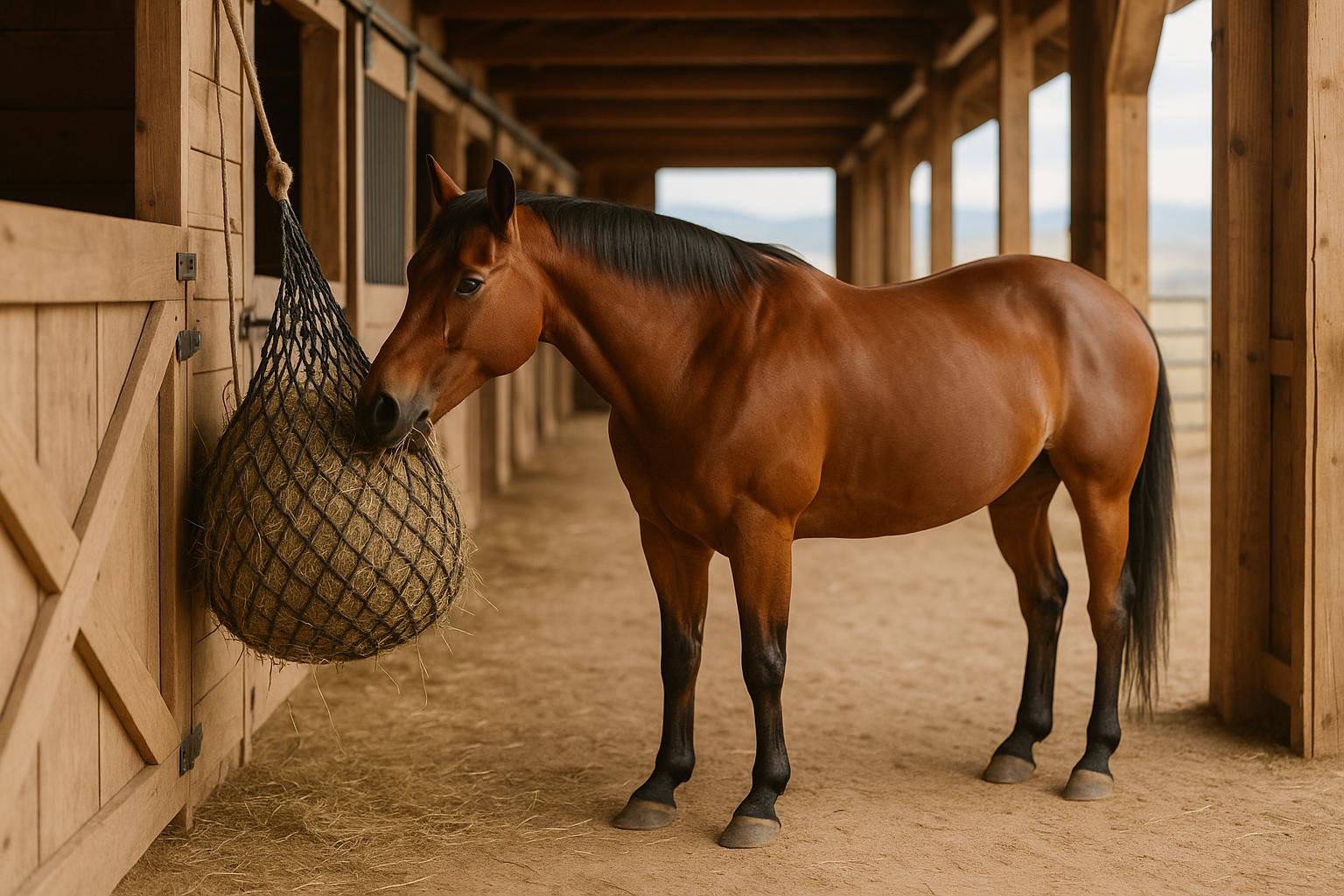
Ask ten boarding barns how much hay a horse gets and you'll get ten different answers, most of them measured in "flakes" — a unit that varies by 30–50% depending on who baled the hay and how tightly. If you've never actually weighed a flake of your own hay, you don't know how much your horse is eating. That's the starting point for everything else in this article.
This is written for the normal adult horse in regular work — not a growing horse, not a senior with age-related needs, not a horse carrying a metabolic condition. If that's your horse, this is your baseline.
Start With Body Weight, Not Guesswork
The forage foundation for a healthy adult horse in maintenance-to-light work is 1.5–2.5% of body weight per day in total feed, with the large majority of that as forage. A 1,100-lb horse in light work needs roughly 16.5–27.5 lbs of total feed daily — most barns land in the 18–22 lb range once you account for hay waste and selective eating.
Weigh your horse if you can (a scale at the vet clinic or feed store), or use a weight tape — less accurate but far better than eyeballing. Then weigh an actual flake of your actual hay on a bathroom or luggage scale once. Most owners are surprised to learn their "two flakes twice a day" habit is delivering anywhere from 60% to 140% of what they assumed.
The Workload Adjustment
Maintenance and light work (trail riding a few times a week, occasional lessons) sits at the lower end of the 1.5–2.5% range and often needs no concentrate at all if the forage is decent quality — a ration balancer to cover mineral gaps is usually the entire "extra" this horse needs.
Moderate work (regular lessons, light showing, several rides a week) typically needs forage plus a modest concentrate to meet elevated calorie and mineral demand, particularly if the horse is a harder keeper at that workload.
Heavy and very heavy work (multiple daily training sessions, performance/competition schedules) is where forage alone genuinely can't deliver enough calories, and a properly formulated performance concentrate becomes necessary rather than optional — that's a deeper topic than this baseline article covers.
The Concentrate Decision Tree
Here's the actual decision, in order:
-
Is the horse holding appropriate body condition on forage alone (plus a ration balancer for minerals)? If yes, you likely don't need a calorie-dense concentrate. A ration balancer — fed at a few ounces to a pound or two daily — closes the mineral and protein gaps that plain hay leaves without adding unnecessary calories.
-
Is the horse losing condition, or is the workload genuinely elevated? This is where a concentrate earns its place — not as a default, but as a response to a documented calorie shortfall.
-
Is the "concentrate" actually just habit? A huge amount of grain fed in the average barn isn't feeding a calculated need — it's feeding tradition ("that's what we've always fed") or feeding the human's instinct that a bucket of grain equals good care. If your horse holds ideal body condition on forage and a balancer, more grain isn't a bonus. It's excess starch and sugar your horse's system has to process for no nutritional benefit — and in some horses, a real metabolic cost.
What Most Barns Get Wrong
The single most common error isn't underfeeding — it's mismatched feeding: too little forage paired with too much concentrate, because concentrate is easier to measure by the scoop and forage is measured by the "eh, that looks about right" flake. Flip that assumption. Forage should be the largest, most carefully accounted-for part of the diet; concentrate should be the smaller, more deliberate addition — sized to an actual gap, not a habit.
The second most common error is not adjusting as workload changes seasonally. A horse in full winter turnout with reduced riding doesn't need the same ration as that horse in full summer competition condition — but a lot of feeding programs stay static year-round regardless.
A Practical Starting Framework
- Weigh the horse (or tape it) and weigh your actual hay flakes — don't estimate either.
- Target 1.5–2.5% of body weight in total feed, forage-forward, adjusted by workload tier.
- Add a ration balancer if forage alone doesn't cover protein and mineral needs (it usually doesn't, fully).
- Add calorie-dense concentrate only in response to a genuine calorie shortfall — documented by body condition, not assumed by habit.
- Reassess as workload or season changes — this isn't a "set once" number.
If you want to know exactly what your specific horse needs rather than working from a general baseline, that's what a consultation is for — bring your horse's weight, workload, and current hay, and we'll build the actual numbers together.
Pure Horse Nutrition provides equine nutrition consulting and educational information. Montana Lowden is not a licensed veterinarian. The information and services provided are not intended to diagnose, treat, cure, or prevent any disease. Always consult your licensed veterinarian regarding your horse's health.
Montana Lowden
Certified equine and human nutritionist. AQHA World Show competitor and Canadian Nationals Horsemanship Champion. Based in Missoula, Montana.
More about MontanaGet articles like this in your inbox.
Bi-weekly notes from Montana — case studies, science, and what's actually working in the barn.