
Feeding the Growing Horse: Nutrition for Foals, Weanlings, and Yearlings
Growth mistakes made at six months show up as joint problems at six years. Here's how to feed a young horse for sound, steady development — not fast development.
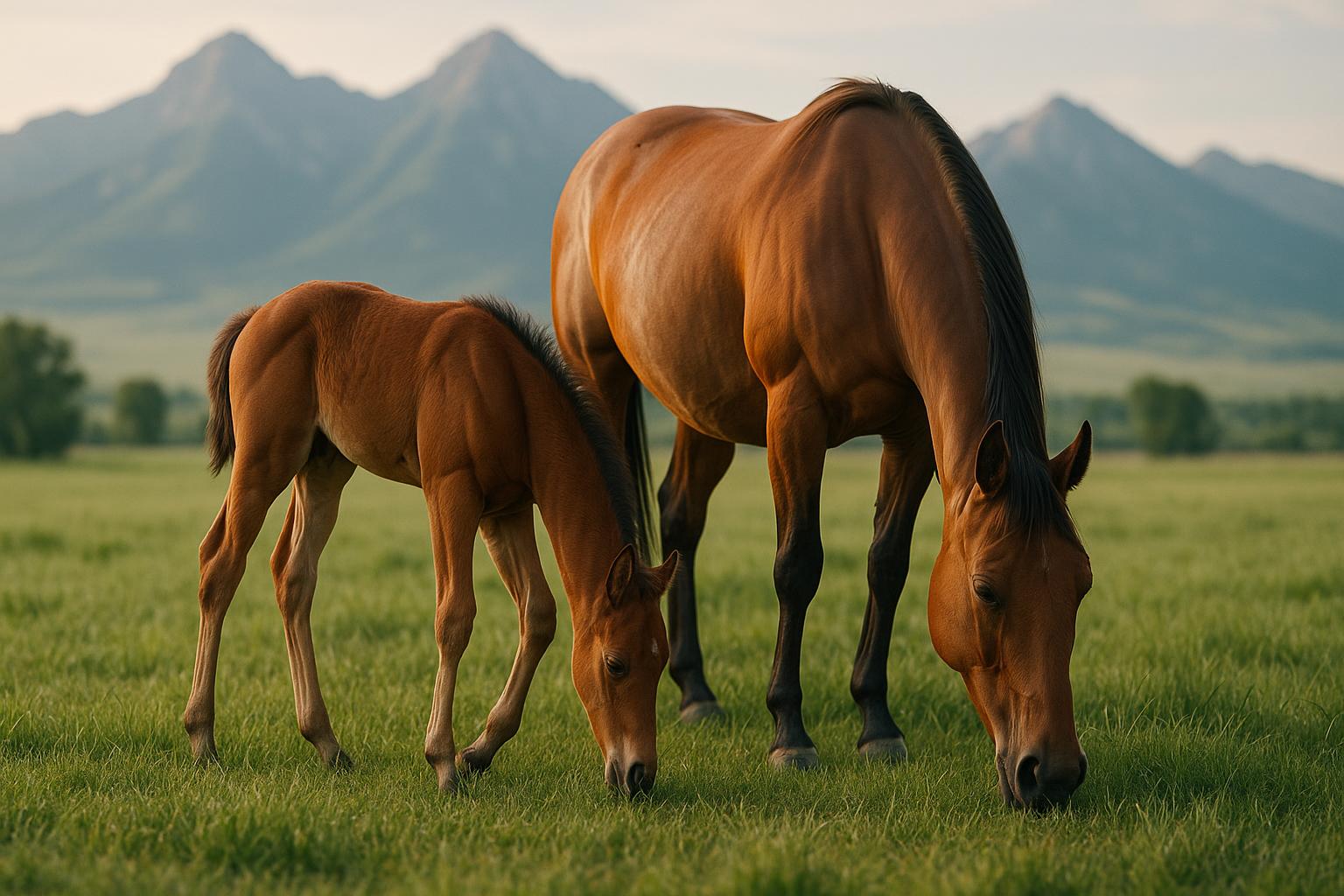
A weanling that grows too fast isn't a success story. It's a horse whose skeleton is being asked to keep up with a growth rate its cartilage and bone density weren't built for — and the bill for that usually comes due as a two-year-old, in the form of a joint that never quite tracked right.
Feeding a growing horse well isn't about maximizing growth. It's about managing the rate and evenness of it. Here's how that actually works.
Why Growth Rate Matters More Than Growth Size
Foals, weanlings, and yearlings are laying down skeletal structure that has to last 25-plus years. The growth plates in a young horse's long bones don't fully close until somewhere between 18 months (in the lower limb) and 3.5 to 4 years (in the vertebrae). Everything that happens nutritionally during that window either supports even, controlled bone and cartilage development — or it doesn't.
Developmental orthopedic disease (DOD) — the umbrella term for physitis, osteochondrosis (OCD), angular limb deformities, and flexural deformities — is overwhelmingly a nutrition-and-growth-rate problem, not a genetics-only problem. The research is consistent on this: rapid, uneven growth spurts (often driven by excess energy relative to mineral supply) are a bigger risk factor than total lifetime growth. A foal that grows slightly slower and steadier will very often out-perform, soundness-wise, a foal pushed to hit "ideal" frame size on an accelerated timeline.
The practical implication: the goal isn't the fastest growth curve. It's the smoothest one. This is the same forage-first logic that underpins healthy digestion at every life stage — see how the digestive system actually works for the fuller picture.
The Energy-to-Mineral Ratio Is the Whole Game
Most well-meaning owners overfeed energy (calories) relative to minerals — usually by free-feeding a high-starch concentrate designed for a mature performance horse, or by overdoing creep feed. Excess digestible energy accelerates growth rate; if calcium, phosphorus, copper, and zinc aren't scaled up to match, the horse is growing bone faster than it's building the mineral matrix to support it.
The two minerals that get the most attention, for good reason:
Calcium and phosphorus, at the correct 1.5–2:1 ratio (Ca:P), are the literal building blocks of bone. Grass hay and most pasture is calcium-adequate but frequently phosphorus-marginal for a growing horse's elevated requirement — this is one of the few situations where a straight grass-hay diet, without a properly formulated growth ration or balancer, can leave a real gap.
Copper and zinc are the minerals most specifically linked to cartilage and connective tissue integrity — copper in particular is required for collagen cross-linking. Research on OCD lesions has repeatedly flagged copper insufficiency during the critical growth window (weanling through yearling) as a contributing factor. This is why a properly formulated foal/weanling feed or ration balancer — not just "more calories" — is the actual fix, not a workaround.
Feeding by Life Stage
Foals (birth to weaning, ~4–6 months): Mare's milk is the foundation for the first few months, but milk production and quality decline well before most foals are ready to be weaned off it nutritionally. Creep feeding — offering a small, foal-specific concentrate the foal can access but the mare mostly can't — from around 8–10 weeks smooths the nutritional transition and reduces the growth check that weaning otherwise causes.
Weanlings (4–12 months): This is the highest-risk window for DOD because it's the period of most rapid skeletal growth relative to body size, and it coincides with a major nutritional transition (mare's milk to solid feed) and often a stressful management change (weaning itself). A properly formulated weanling feed, fed at label rate alongside good-quality forage, is the standard approach — not because "more is better" but because weanling requirements for protein (with adequate lysine), calcium, phosphorus, copper, and zinc are genuinely elevated relative to body weight in a way forage alone usually can't meet.
Yearlings (1–2 years): Growth rate slows but doesn't stop — significant frame development continues, especially in breeds selected for mature size. This is often where overfeeding creeps in, particularly with young horses being prepped for in-hand showing or early sales, where a "fitter," heavier-topped yearling is cosmetically rewarded. Resist the pressure to push condition ahead of skeletal readiness.
Long yearlings into two-year-olds: As horses approach the age where training may begin, body condition should reflect fitness for the intended use, not maximum frame. This is a conversation to have with your vet and trainer jointly, not a nutrition decision made in isolation.
Body Condition in the Growing Horse
Body condition scoring works differently in a young, growing horse than in a mature one — you're evaluating whether the horse looks appropriately covered for its growth stage, not scoring against the same fat-deposition landmarks used for an adult. A weanling that looks "ribby" alongside visible growth plates at the knees and hocks warrants a hard look at the feeding program; so does one carrying visibly excess condition on a still-developing frame. Neither extreme is the goal — even, moderate condition through the growth window is.
What to Watch For
Physitis (swelling and heat around the growth plates, most commonly at the fetlock and knee) is often the earliest visible sign that growth rate has outpaced the horse's ability to remodel bone evenly. It's frequently a signal to reduce energy intake, not add more supplements on top. Angular limb deviations that worsen rather than improve with normal growth, or any joint that stays consistently filled or warm, are vet-exam territory — this is a mechanical and growth-plate question a nutrition adjustment alone won't resolve.
The Practical Takeaway
Feed a properly formulated foal, weanling, or yearling ration at the manufacturer's recommended rate for the horse's age and weight — not a mature-horse concentrate, and not "just good hay" alone once the horse is past early weanling age. Have forage tested if you're relying on it for more than a small percentage of the diet. Track growth with a weight tape or scale monthly rather than eyeballing it, since visual assessment consistently underestimates how quickly young horses change. And if you see uneven growth, joint filling, or a limb deviation that isn't improving, that's a vet-and-nutritionist conversation together, not a wait-and-see.
If you're not sure whether your young horse's current program is supporting steady, sound growth, that's exactly the kind of question a consultation is built for — bring your forage analysis and current feeding program, and we'll work through it together.
Pure Horse Nutrition provides equine nutrition consulting and educational information. Montana Lowden is not a licensed veterinarian. The information and services provided are not intended to diagnose, treat, cure, or prevent any disease. Always consult your licensed veterinarian regarding your horse's health.
Montana Lowden
Certified equine and human nutritionist. AQHA World Show competitor and Canadian Nationals Horsemanship Champion. Based in Missoula, Montana.
More about MontanaGet articles like this in your inbox.
Bi-weekly notes from Montana — case studies, science, and what's actually working in the barn.